Wednesday, May 2, 2012
Disjoi ted post in progess ignore for now... celdt vs book on standardized testint, how celdt qs,some fluent kids prob wont pass due to stupid rubrics. 4 pics, explain. To really pass, need detail. Reg kids dont give the detail of a 4, a A grade score let alone english learners. Or certain pics ie gas pump, from the 40s look nothing like todays, some wont know what it is so they fail the queation. Not that that dont know ebglish heck i had to look at it twice.

Saturday, April 14, 2012
But wait there's more
..If you read backwards....as this refers to my previous post below this one. Anyways....read that one first...
from http://andrewgavinmarshall.com/2012/04/13/571/
meh...more later perhaps.
from http://andrewgavinmarshall.com/2012/04/13/571/
Therein lies the dichotomy: one form of education is for social control and domination, the other is for social uplift and rejuvenation; one type of intellectual is a programmatic priest for the proselytization of power, the other is an energetic and empowering enemy of entrenched elites.
Whether public or private, the key issue at hand is that of the utility – or purpose – of higher education. Conventional wisdom inflates the classical liberal concept of higher education as a social good, one which may be funded by the state in order to promote the general well-being of society, as inherently cultural institutions designed to raise the intellectual, spiritual, moral, and philosophical standards of society. A more critical history of education tends to downplay the “social good” theory in place of a “social control” theory of education, and specifically, of the social sciences. In this conception, education was designed to produce professional ‘technicians’ who would – using the techniques of science, rationality, and reason – study social problems with a desire to find and recommend specific policies and programs to ameliorate those problems – to promote reforms to the social system – in order to maintain “order.” Order, in this case, is understood as maintaining the social hierarchy. We understand “social order” as the security of the “social hierarchy” precisely because ‘disorder’ is understood as the opposite of this: a threat to the prevailing social hierarchy and institutional structure of society. Order is maintained through manufacturing ideologies, implementing policies, and undertaking programs of social engineering all with a desire to establish ‘social control.’
oh and oopsy, from my last post something I forgot to include but will here being of the same author,
This era marked the emergence of what has been referred to as “technocratic liberalism,” whereby social problems were addressed (in large part by the state, or at least state sanction) through the technical application of programs of social engineering: “the one best way,” the most efficient, effective, and “scientific” approach to understanding and addressing social problems. This was the task taken up by the “rational reformers” of the era, emerging out of the Progressive period, in which the techniques of the social sciences were used to create a system of “social control.” These social engineers– social scientists, technocratic reformers, experts, philanthropists, etc. – felt that society could “control its collective destiny in contrast to drifting with the tides… even while working toward the management of the many by the few.”[57]and back to the article at hand,
The difference in ideology then, is that the word is used to deride and dismiss theories and ideas which challenge, critique, or oppose power, hierarchy, and the status quo. Those ideas, theories, philosophies and perspectives which support power, hierarchy, and the status quo, are not presented as “ideology,” but as “disinterested knowledge,” as a fact, not in need of proof, but of an assumed nature. They are simply accepted, and are therefore, not ideology. This is also widely reflected in the differences of the academic journals, between those which are establishment and elitist, and those which are critical and allow for more dissent. An example is Foreign Affairs, the premier foreign policy journal, run by the Council on Foreign Relations, the most influential think tank in the United States. In this journal, the articles and essays, written by various “experts” and active, former, or prospective policy-makers and those who hold seats of power, contain largely little or no citations whatsoever. All the ‘facts’ and ideas stated within the articles do not need citations or references because they are ideas which support the status quo, and therefore, they simply reflect the ‘perceived’ realities of society.
meh...more later perhaps.
Yep another Copy/Paste no commentary post...
Yep another C&P post without commentary....but worth a read. I pondered upon these articles today and to really "get' them, read them, but I wanted to share key bits that I found of particular interest.

From http://andrewgavinmarshall.com/2012/04/02/class-war-and-the-college-crisis-the-crisis-of-democracy-and-the-attack-on-education/

and
and
 Forget the poor, black, and disenfranchised segments of society; forget the disabled, the labeled, and the imprisoned; forget those on welfare, food stamps, dependent upon social services or local charity; forget the entire population of the United States, who can only incite government recognition and support after years of struggle, constant protests, police repression, assault, c
urtailment of basic human rights and dignity; those struggles which seek only the attainment of a genuine status of human being, to be treated equal and fair… no, forget those people! The true “forgotten” and “oppressed” are the executives at Union Carbide, Exxon, General Electric, GM, Ford, DuPont, Dow, Chase Manhattan, Bank of America, and Monsanto. They, truly, are the disenfranchised… At least, according to Lewis Powell
and
But wait there's more! From http://andrewgavinmarshall.com/2012/04/08/the-purpose-of-education-social-uplift-or-social-control/
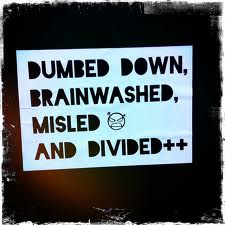
and
and
And there's a third article too.....
From http://andrewgavinmarshall.com/2012/04/02/class-war-and-the-college-crisis-the-crisis-of-democracy-and-the-attack-on-education/
Huntington identifies “the blacks” as one such group that had become politically active, posing a “danger of overloading the political system with demands.” Of course, this implies directly an elitist version of “democracy” in which the state retains the democratic aesthetic (voting, separation of powers, rule of law) but remains exclusively in the hands of the wealthy power elite. Huntington, in his conclusion, stated that the vulnerability of democracy – the ‘crisis of democracy’ – comes “from the internal dynamics of democracy itself in a highly educated, mobilized, and participant society,” and that what is needed is “a more balanced existence” in which there are “desirable limits to the indefinite extension of political democracy.”[3] In other words, what is needed is less democracy and more authorityand
The Trilateral Commission further sent rampant shivers through the intellectual elite community by discussing the perceived threat of “value-oriented intellectuals” who dare to “assert their disgust with the corruption, materialism, and inefficiency of democracy and with the subservience of democratic government to ‘monopoly capitalism’.” For the members and constituents (elites) of the Trilateral Commission, they did not hold back on the assessment of such a threat, stating that, “this development constitutes a challenge to democratic government which is, potentially at least, as serious as those posed in the past by the aristocratic cliques, fascist movements, and communist parties.”[5] This is a very typical elitist use of rhetoric in which when identifying any perceived threat to elite interests, they are portrayed in near-apocalyptic terms. The implication, therefore, is that intellectuals who challenge authority are presented as much of a threat to democracy as Hitler and fascism were....The Trilateral Commission report explained – through economic reasoning – how increased democracy is simply unsustainable. The “democratic surge” gave disadvantaged groups new rights and made them politically active (such as blacks), and this resulted in increased demands upon the very system whose legitimacy had been weakened. A terrible scenario for elites!
and
The “threat” of educated youth was especially pronounced. In 1978, the Management Development Institute (a major business school in India) released a report in which it stated:
perhaps the most pernicious trend over the next decade is the growing gap between an increasingly well educated labor force and the number of job openings which can utilize its skills and qualifications… The potential for frustration, alienation and disruption resulting from the disparity between educational attainment and the appropriate job content cannot be overemphasized.[11]
In these commentaries, we are dealing with two diametrically opposed definitions of democracy: popular and elitist. Popular democracy is government of, by, and for the people; elitist democracy is government of, by, and for the rich (but with the outward aesthetic of democracies), channeling popular participation into voting instead of decision-making or active participation. Popular democracy implies the people participating directly in the decisions and functions and maintenance of the ‘nation’ (though not necessarily the State); whereas elitist democracy implies passive participation of the population so much as to allow them to feel as if they play an important role in the direction of society, while the elites control all the important levers and institutions of power which direct and benefit from the actions of the state.
and
urtailment of basic human rights and dignity; those struggles which seek only the attainment of a genuine status of human being, to be treated equal and fair… no, forget those people! The true “forgotten” and “oppressed” are the executives at Union Carbide, Exxon, General Electric, GM, Ford, DuPont, Dow, Chase Manhattan, Bank of America, and Monsanto. They, truly, are the disenfranchised… At least, according to Lewis Powell
and
Debt thus disciplines the student toward a different purpose in their education: toward a job and financial benefits rather than toward knowledge and understanding. Activism then, is more of an impediment to, rather than a supporter of knowledge and education.
But wait there's more! From http://andrewgavinmarshall.com/2012/04/08/the-purpose-of-education-social-uplift-or-social-control/
The spread of ‘mass education’ of primary and secondary education from the Prussian system in the 18th century was designed to socialize the population into a state-structured ideology (taking the monopoly of education away from the religious and community institutions and into the hands of the emerging nation-state). The aim, therefore, of mass – or public – education was not a benevolent concept of expanding and sharing knowledge (as is purported in liberal thought), but rather as a means to foster patriotism and support the state system in preserving the social class structures. In 1807, Johann Gottlieb Fichte, one of the founding philosophers of this system, explained that educated was the means toward fostering patriotism, as “universal, state-directed, compulsory education would teach all Germans to be good Germans and would prepare them to play whatever role – military, economic, political – fell to them in helping the state reassert Prussian power.”[1] As British philosopher Bertrand Russell explained:Fichte laid it down that education should aim at destroying free will, so that, after pupils have left school, they shall be incapable, throughout the rest of their lives, of thinking or acting otherwise than as their schoolmasters would have wished.[2]......The lower levels of education are directed at producing “general outputs for society,” while the higher levels may actually reflect and affect “socially and politically constituted authority.” In short, the lower levels produce the masses, while the higher levels may produce the managers. The university system is the dominant form of higher education in the world, far outweighing other forms of educational institutions that have existed through history.
and
The Robber Baron industrialists of the late 19th century – Morgan, Rockefeller, Carnegie, Astor, Vanderbilt, Harriman, etc. – were unquestionably the dominant powers in the country. They controlled the economy, hundreds of corporations, had hundreds of millions or billions in wealth, the banks, bought the politicians, directed foreign policy into an increasingly imperialistic direction, and thus, they saw it as essential to cement their control over society through social institutions, as the masses were hateful of them and needed to be properly controlled. Social control became the major concept of interest for elites and middle class reformers.andIn this era of social control, education became increasingly important, not only in terms of mass schooling, which experienced many reforms, but also in terms of the university system. As Andrew Carnegie wrote in 1889, at the top of the list of “charitable deeds” to undertake was “the founding of a university by men enormously rich, such men as must necessarily be few in any country.”

with the idea of “science in the service of society” as a goal for the foundation, basing its actions upon a new rationality brought on by the scientific revolution, and by the notions of reform pushed forward in the Progressive Era, based largely upon the concept of scientific social planning “to problems that educators, the new sociologists, social workers, and political scientists found important.” However, as the wealth of the foundations and the positions of their patrons attracted criticisms, a Congressional commission was on industrial relations (founded to settle a matter related to a brutal repression of a mining strike by a Rockefeller-owned mining company) expanded its scope to deal with the general issue of the foundations. The Walsh Commission, as it was known (after its founder, Frank P. Walsh), was formed in 1914, and Walsh explained the inclusion of the foundations in the commission by postulating that:
the creation of the Rockefeller and other foundations was the beginning of an effort to perpetuate the present position of predatory wealth through the corruption of sources of public information… [and] that if not checked by legislation, these foundations will be used as instruments to change to form of government of the U.S. at a future date, and there is even a hint that there is a fear of a monarchy.[35]
In 1916, the Walsh Commission produced its final report, the Manly Report (after the research director, Basil M. Manly), which concluded that the foundations were so “grave a menace” to society, that “it would be desirable to recommend their abolition.” No such actions were taken.[36]
and
In 1932-33, as the Board was considering the proposals of reform in education, all the programs were subject to the ultimate approval of the Board of Trustees of the GEB, which at the time included 15 individuals, all of whom were white, male protestants, including John D. Rockefeller, Jr., and his 27 year old son, John D. Rockefeller, III, and most of whom had been educated at Ivy League schools or the University of Chicago, which had been founded by John D. Rockefeller. Nine of the fifteen trustees were also academics, and seven of them had been senior administrators at major educational institutions, including Harvard, Yale, Princeton, Dartmouth, N.Y.U, Stanford, and the University of Chicago. Other members of the trustees included Owen Young, Chairman of the Board of General Electric, as well as banker Arthur Woods, and Raymond Fosdick, a Wall Street lawyer who would later become President of the Rockefeller Foundation. By 1931, the GEB’s survey of education emphasized three major fields of concentration:1) the study of the learning process and the mental, physical, and moral development of the individual; 2) the problem of “preparing the individual for vocations and leisure”; and 3) the means for relating education to an evolving society, that is education which would “insure the active adaptation of the individual to the changes which may come in his social, physical and aesthetic environments.”[49]
And there's a third article too.....
Friday, April 13, 2012
OWS Arab Spring Agenda 21 and more.... a 1932 time warp
From http://courses.wccnet.edu/~palay/cls2002/counts.htm an article by George S Counts in 1932.....some things that seem much too prophetic, his 1932 sounds like today, the cries of OWS, the ideas of Agenda 21, etc....
Bear with me as a give a smattering of lengthy verbose quotes from the article, without commentary...but I feel if you take the time to read them, they speak for themselves.
 The need for the founding of Progressive Education on an
adequate social theory is peculiarly imperative today. We live in troublous
times; we live in an age of profound change; we live in an age of revolution.
Indeed, it is highly doubtful whether man ever lived in a more eventful period
than the present. In order to match our epoch we would probably have to go back
to the fall of ancient empires, or even to that unrecorded age when men first
abandoned the simple arts of hunting and fishing and trapping and began to
experiment with agriculture and the settled life. Today we are witnessing the
rise of civilization quite without precedent in human history -- a civilization
which is founded on science, technology, and machinery, which possesses the most
extraordinary power, and which is rapidly making the entire world a single great
society. As a consequence of forces already released, whether in the field of
economics, politics, morals, religion, or art, the old molds are being broken.
And the peoples of the earth are seething with strange ideas and passions. If
life were peaceful and quiet and undisturbed by great issues, we might, with
some show of wisdom, center our attention on the nature of the child. But with
the world as it is, we cannot afford for a single instant to remove our eyes
from the social scene.


Bear with me as a give a smattering of lengthy verbose quotes from the article, without commentary...but I feel if you take the time to read them, they speak for themselves.
In this new world that is forming, there is one set of issues
which is peculiarly fundamental, and which is certain to be the center of bitter
and prolonged struggle. I refer to those issues which may be styled economic.
President Butler has well stated the case: "For a generation and more past," he
says, "the center of human interest has been moving from the point which it
occupied for some four hundred years to a new point which it bids fair to occupy
for a time equally long. The shift in the position of the center of gravity in
human interest has been from politics to economics; from considerations that had
to do with forms of government, with the establishment and protection of
individual liberty, to considerations that have to do with the production,
distribution, and consumption of wealth."
and,

Consider the situation in which we find ourselves today. How the gods must laugh at human folly! And who among us, if he had not been reared among our institutions, could believe his eyes as he surveys the economic situation, or his ears as he listens to solemn disquisitions by our financial and political leaders on the cause and cure of the depression! Here is a society in which a mastery over the forces of nature, surpassing the wildest dreams of antiquity, is accompanied by extreme material insecurity; in which dire poverty walks hand in hand with the most extravagant living that the world has ever known; in which an abundance of goods of all kinds is coupled with privation, misery, and even starvation; in which an excess of production is seriously offered as the underlying cause of severe physical suffering; in which breakfastless children march to school past bankrupt shops laden with rich foods gathered from the ends of the earth; in which strong men by the millions walk the streets in a futile search for employment and, with the exhaustion of hope, enter the ranks of beaten men; in which so-called captains of industry close factories without warning and dismiss the workmen by whose labors they have amassed great fortunes through the years; in which automatic machinery increasingly displaces men and threatens the economic order with a growing contingent of the permanently unemployed; in which racketeers and gangsters, with the connivance of public officials, fasten themselves on the channels of trade and exact toll at the end of the machine gun; in which economic parasitism, either within or without the law, has become so easy for the cunning and the ruthless that the tradition seems to be taking root that "only saps work"; in which the wages paid to the workers are too meagre to enable them to buy back the goods they produce; in which consumption is subordinated to production and the science of psychology is employed to fan the flames of desire; in which a governmental commission advises cotton growers to plow under every fourth row of cotton in order to bolster up the market; in which both ethical and esthetic considerations are commonly over-ridden by "practical" men bent on material gain; in which the dole to the unemployed is opposed on the grounds that it will pauperize the masses when the favored classes, through the institution of interest, have always lived on the dole; in which our most responsible leaders, not knowing what to do, resort to the practices of the witch doctor and vie with one another in predicting the return of prosperity; in which an ideal of rugged individualism, evolved in a simple pioneering and agrarian order at a time when free land existed in abundance, is used to justify a system, which exploits pitilessly and without thought of the morrow, the natural and human resources of the nation and the world. One can only imagine what Jeremiah would say if he could step out of the pages of the Old Testament and cast his eyes over this

and yet some more....yes, I bring in education here....
The achievement of this goal, however, would seem to require
fundamental changes in the economic system. Historic capitalism, with its
deification of the principle of selfishness, its reliance upon the forces of
competition, its placing of property above human rights, and its exaltation of
the profit motive, will either have to be displaced altogether, or so radically
changed in form and spirit that its identity will be completely lost. In view of
the fact that the urge for private gain tends to debase everything that it
touches, whether business, recreation, religion, art, or friendship, the
indictment against capitalism might well be made on moral grounds. And these are
the grounds on which the attack has commonly been made in the past. Today,
however, capitalism is proving itself weak at the very point where it has
generally been thought impregnable – in the organization and the maintenance of
production. In its present form capitalism is not only cruel and inhuman; it is
also wasteful and inefficient. It has exploited our natural riches without the
slightest regard for the future; it has made technology serve the interests of
the profit motive; it has chained the engineer to the vagaries of the price
system; it has plunged great nations of the world into a succession of wars,
ever more devastating and catastrophic in character; and only recently, it has
brought on a world crisis of such dimensions that millions of men in all of the
great industrial countries have been thrown out of work and a general condition
of paralysis pervades the entire economic order. Obviously, the growth of
science and technology has reached a point where competition must be replaced by
coöperation, the urge for profits by careful planning, and private capitalism by
some form of socialized economy.
Changes in our economic system will, of course, require changes
in our ideals. The individualism of the pioneer or the farmer, produced by free
land, great distances, economic independence, and a largely self-sustaining
family economy, is already without solid foundation in either agriculture or
industry. The free land has long since disappeared, the great distances have
been shortened immeasurably by invention, the economic independence survives
only in the traditions of our people, and the self-sustaining family economy has
been swallowed up in a vast society which disregards the boundaries of nations.
Already we live in an economy which, in its function, is fundamentally
coöperative. There merely remains the task of reconstructing our economic forms
and of reformulating our social ideals so that they may be in harmony with the
underlying facts of life. The man who would live unto himself alone is now a
public enemy; the day of individualism in the economic sphere is gone.

To those who fear that the development of a coördinated,
planned, and socialized economy may be accompanied by a severe curtailment of
personal freedom, there are several things to be said. That under such an
economy the actions of the individuals in certain directions would be limited is
fairly obvious. No one would be permitted to build a new factory or railroad
wherever he pleased; also no one would be permitted to amass great riches by
manipulating the economic institutions of the country. On the other hand, by
means of the complete and uninterrupted functioning of the economic system the
foundations could be laid for the a measure of freedom in the realm of personal
life that mankind has never known in the past. Freedom without a secure economic
base is simply no freedom at all. Thus, in comparison with the right to work and
eat, the right to vote is but an empty bauble. Today only the plutocracy have
freedom with an economic support; and even in their case this freedom may be
rather precarious. If all of us could be assured of material security and
abundance, we would be released from economic worries and our minds set free to
grapple with the really important questions of life – the intellectual, the
moral, and the esthetic. The point should also be made that the full utilization
of modern technology, a condition on which our entire argument rests, requires
the planning and coördination of economic processes. We might, of course,
resolve to retire into the simple agrarian society of the past; but we could
scarcely hope to persuade many of our fellow men to follow us. And, no doubt,
those few who might make such a resolution would like to take with them certain
of the fruits of industrialism – bathtubs, electricity, and various labor-saving
devices.

The problem of the reconstruction of our economic order,
however, is not the only problem that we face. Profound changes in this realm
are being accompanied and must be accompanied by equally profound changes in
other fields. Life cannot be divided neatly into a number of separate
compartments. The reduction of the hours of labor and the ushering in of an age
of material abundance must have severe repercussions in the spheres of art,
government, morals, and religion. Indeed, we see this very thing happening in
contemporary society today. And while in the present paper attention is centered
on the economic question, our educational theory will have to embrace the entire
range of life. It will have to deal, not only with labor and income and
property, but also with leisure and recreation, sex and family, government and
public opinion, race and nationality, war and peace, art and esthetics.
Tuesday, April 10, 2012
Eugenics Alive and Well Today
So this will be a disjointed post, more to just collect information and thoughts.

The study and worship of eugenics is alive....not dead....
I was researching the notion of racial inferority and IQ and found an article that led to another and another....you get the idea...and I came across this,
http://www.news-medical.net/news/2005/04/26/9530.aspx
Which claims....
The authors, and a person who compliments their work are: J Philippe Rushton and Arthur R Jensen, and their "worshipper" giving praise, Linda Gottfredson. So who are Rushton, Jenses, Gottfredson?
Well, Jensen has received over $1million from the Pioneer Fund. More on them later. Other stuff about him, prof. emeritus of Educational Psych at UC Berkeley, got his phD from Columbia and did post-doc research in psychiatry. (Great so his racist ideas were taught to our teachers!) He was named as one of the 100 most eminent psychologists of the 20th century. Has authored over 435 articles books etc.
Rushton is head of the Pioneer Fund, and member of the American, Canadian, British Psych. Associations. He bounced around many universities for his education, and has taught psychology in many universities as well.
Gottfredson got her BA in Psych from UC Berkeley, and a PhD (Sociology) from John Hopkins. To cut and paste from wikipedia...
Board of directors, International Society for the Study of Individual Differences, 2005–present.
Editorial board, Learning and Individual Differences, 2004–present.
Editorial board, Intelligence, 2004–present.
Advisory board, International Society for Intelligence Research, 2000–present (Founding Member).
Board of editorial advisors, Society, 1997–present.
Editorial board, The Psychologist-Manager Journal, 1997-2000.
National Council, Federation of American Scientists, 1995-1999.
Testimony before the House Judiciary Committee, Subcommittee on the Constitution, Oversight hearing on the Civil Rights Division of the Department of Justice, Washington, D.C., May 20, 1997.
Board of directors, Society of Psychologists in Management, 1994-1997.
Board of directors, Society for the Study of Social Biology, 1990-1994.
Editorial board, Journal of Vocational Behavior, 1983-1990.
Consultant, Department of Labor (DOT revision [APDOT, contract to American Psychological Association], implementation of "Goals 2000" [contract to Institute for Educational Leadership]), 1992-1995.
Consultant, Department of Defense Student Testing Program contract awarded to Booz-Allen, Inc. 1989-1991.
Panel member, Advisory Panel on the Identification of Alternative Approaches for reporting Armed Services Vocational Aptitude Battery (ASVAB) scores. U.S. Manpower Entrance Processing Command, San Antonio, TX, November 1987.
Consultant, U.S. Commission on Civil Rights, 1987-1989.
Wow just wow.....she is racist/eugenic, teaching our teachers to follow suit, encouraging MORE testing in schools, businesses, military, managing of people, social biology (ahem eugenics) and civil rights. What a crock. She is a Professor at U Delaware of Educational Psychology.
The Pioneer Institute....? Their first president was H. H. Laughlin, director of the Eugenics Record Office at Cold Springs Harbor, funded by Carnegie; Princeton PhD grad.
Go visit http://www.pioneerfund.org/Founders.html for more, their founders were all eugenicists and the Pioneer Fund exists today, Rushton their head, enjoy!
The study and worship of eugenics is alive....not dead....
I was researching the notion of racial inferority and IQ and found an article that led to another and another....you get the idea...and I came across this,
http://www.news-medical.net/news/2005/04/26/9530.aspx
Which claims....
- The Worldwide Pattern of IQ Scores. East Asians average higher on IQ tests than Whites, both in the U. S. and in Asia, even though IQ tests were developed for use in the Euro-American culture. Around the world, the average IQ for East Asians centers around 106; for Whites, about 100; and for Blacks about 85 in the U.S. and 70 in sub-Saharan Africa.
- Race Differences are Most Pronounced on Tests that Best Measure the General Intelligence Factor (g). Black-White differences, for example, are larger on the Backward Digit Span test than on the less g loaded Forward Digit Span test.
- The Gene-Environment Architecture of IQ is the Same in all Races, and Race Differences are Most Pronounced on More Heritable Abilities. Studies of Black, White, and East Asian twins, for example, show the heritability of IQ is 50% or higher in all races.
- Brain Size Differences. Studies using magnetic resonance imaging (MRI) find a correlation of brain size with IQ of about 0.40. Larger brains contain more neurons and synapses and process information faster. Race differences in brain size are present at birth. By adulthood, East Asians average 1 cubic inch more cranial capacity than Whites who average 5 cubic inches more than Blacks.
- Trans-Racial Adoption Studies. Race differences in IQ remain following adoption by White middle class parents. East Asians grow to average higher IQs than Whites while Blacks score lower. The Minnesota Trans-Racial Adoption Study followed children to age 17 and found race differences were even greater than at age 7: White children, 106; Mixed-Race children, 99; and Black children, 89.
- Racial Admixture Studies. Black children with lighter skin, for example, average higher IQ scores. In South Africa, the IQ of the mixed-race "Colored" population averages 85, intermediate to the African 70 and White 100.
- IQ Scores of Blacks and Whites Regress toward the Averages of Their Race. Parents pass on only some exceptional genes to offspring so parents with very high IQs tend to have more average children. Black and White children with parents of IQ 115 move to different averages--Blacks toward 85 and Whites to 100.
- Race Differences in Other "Life-History" Traits. East Asians and Blacks consistently fall at two ends of a continuum with Whites intermediate on 60 measures of maturation, personality, reproduction, and social organization. For example, Black children sit, crawl, walk, and put on their clothes earlier than Whites or East Asians.
- Race Differences and the Out-of-Africa theory of Human Origins. East Asian-White-Black differences fit the theory that modern humans arose in Africa about 100,000 years ago and expanded northward. During prolonged winters there was evolutionary selection for higher IQ created by problems of raising children, gathering and storing food, gaining shelter, and making clothes.
- Do Culture-Only Theories Explain the Data? Culture-only theories do not explain the highly consistent pattern of race differences in IQ, especially the East Asian data. No interventions such as ending segregation, introducing school busing, or "Head Start" programs have reduced the gaps as culture-only theory would predict.
The authors, and a person who compliments their work are: J Philippe Rushton and Arthur R Jensen, and their "worshipper" giving praise, Linda Gottfredson. So who are Rushton, Jenses, Gottfredson?
Well, Jensen has received over $1million from the Pioneer Fund. More on them later. Other stuff about him, prof. emeritus of Educational Psych at UC Berkeley, got his phD from Columbia and did post-doc research in psychiatry. (Great so his racist ideas were taught to our teachers!) He was named as one of the 100 most eminent psychologists of the 20th century. Has authored over 435 articles books etc.
Rushton is head of the Pioneer Fund, and member of the American, Canadian, British Psych. Associations. He bounced around many universities for his education, and has taught psychology in many universities as well.
Gottfredson got her BA in Psych from UC Berkeley, and a PhD (Sociology) from John Hopkins. To cut and paste from wikipedia...
The Pioneer Institute....? Their first president was H. H. Laughlin, director of the Eugenics Record Office at Cold Springs Harbor, funded by Carnegie; Princeton PhD grad.
Go visit http://www.pioneerfund.org/Founders.html for more, their founders were all eugenicists and the Pioneer Fund exists today, Rushton their head, enjoy!
Tuesday, March 27, 2012
educational philosophy quiz
http://highered.mcgraw-hill.com/sites/0072877723/student_view0/chapter9/what_do_you_think_.html
I tied my highest score for perenialism and existentialism (22). My lowest was social reconstructionism (13), makes sense, followed by progressivism.
You see a graph of all responses. For those that think my chastising of progressivism, social control in education is out dated, not happening, think again. The new teachers and those in teaching colleges have scores here which align with the highest score in progressivism (22) followed by a close second, social reconstructionism (21). The lowest is existentialism (14).
EXISTENTIALISM: Related to education, the subject matter of existentialist classrooms should be a matter of personal choice. Teachers view the individual as an entity within a social context in which the learner must confront others' views to clarify his or her own. Character development emphasizes individual responsibility for decisions. Real answers come from within the individual, not from outside authority. Examining life through authentic thinking involves students in genuine learning experiences. Existentialists are opposed to thinking about students as objects to be measured, tracked, or standardized. Such educators want the educational experience to focus on creating opportunities for self-direction and self actualization. They start with the student, rather than on curriculum content. (YES!!! THIS IS WHAT EDUCATION SHOULD BE! IS IT ANY WONDER THAT MOST TEACHERS RATE LEAST IN THIS?)
ESSENTIALISM is an educational philosophy whose adherents believe that children should learn the traditional basic subjects thoroughly and rigorously. In this philosophical school of thought, the aim is to instill students with the "essentials" of academic knowledge, enacting a back-to-basics approach. Essentialism ensures that the accumulated wisdom of our civilization as taught in the traditional academic disciplines is passed on from teacher to student. Such disciplines might include Reading, Writing, Literature, Foreign Languages, History, Mathematics, Science, Art, and Music. Moreover, this traditional approach is meant to train the mind, promote reasoning, and ensure a common culture.
PERRENIALISM Perennialists believe that one should teach the things that one deems to be of everlasting importance to all people everywhere. They believe that the most important topics develop a person. Since details of fact change constantly, these cannot be the most important. Therefore, one should teach principles, not facts. Since people are human, one should teach first about humans, not machines or techniques. Since people are people first, and workers second if at all, one should teach liberal topics first, not vocational topics.
A particular strategy with modern perennialists is to teach scientific reasoning, not facts. They may illustrate the reasoning with original accounts of famous experiments. This gives the students a human side to the science, and shows the reasoning in action. Most importantly, it shows the uncertainty and false steps of real science.
Although perennialism may appear similar to essentialism, perennialism focuses first on personal development, while essentialism focuses first on essential skills. Essentialist curricula thus tend to be much more vocational and fact-based, and far less liberal and principle-based. Both philosophies are typically considered to beteacher-centered, as opposed to student-centered philosophies of education such asprogressivism. However, since the teachers associated with perennialism are in a sense the authors of the Western masterpieces themselves, these teachers may be open to student criticism through the associated Socratic method, which, if carried out as true dialogue, is a balance between students, including the teacher promoting the discussion. (ehh I kinda agree and don't. I scored high because I believe we are not to train workers but minds. I like facts but think we do need to train how to think, scientific reason for example.)
PROGRESSIVISM Progressivists believe that education should focus on the whole child, rather than on the content or the teacher. This educational philosophy stresses that students should test ideas by active experimentation. Learning is rooted in the questions of learners that arise through experiencing the world. It is active, not passive. The learner is a problem solver and thinker who makes meaning through his or her individual experience in the physical and cultural context. Effective teachers provide experiences so that students can learn by doing. Curriculum content is derived from student interests and questions. The scientific method is used by progressivist educators so that students can study matter and events systematically and first hand. The emphasis is on process-how one comes to know. The Progressive education philosophy was established in America from the mid 1920s through the mid 1950s. John Dewey was its foremost proponent. One of his tenets was that the school should improve the way of life of our citizens through experiencing freedom and democracy in schools. Shared decision making, planning of teachers with students, student-selected topics are all aspects. Books are tools, rather than authority.
SOCIAL RECONSTRUCTIONISM
- Social reconstructionism is a philosophy that emphasizes the addressing of social questions and a quest to create a better society and worldwide democracy. Reconstructionist educators focus on a curriculum that highlights social reform as the aim of education. Theodore Brameld (1904-1987) was the founder of social reconstructionism, in reaction against the realities of World War II. He recognized the potential for either human annihilation through technology and human cruelty or the capacity to create a beneficent society using technology and human compassion. George Counts (1889-1974) recognized that education was the means of preparing people for creating this new social order.
Critical theorists, like social reconstructionists, believe that systems must be changed to overcome oppression and improve human conditions. Paulo Freire (1921-1997) was a Brazilian whose experiences living in poverty led him to champion education and literacy as the vehicle for social change. In his view, humans must learn to resist oppression and not become its victims, nor oppress others. To do so requires dialog and critical consciousness, the development of awareness to overcome domination and oppression. Rather than "teaching as banking," in which the educator deposits information into students' heads, Freire saw teaching and learning as a process of inquiry in which the child must invent and reinvent the world.
For social reconstructionists and critical theorists, curriculum focuses on student experience and taking social action on real problems, such as violence, hunger, international terrorism, inflation, and inequality. Strategies for dealing with controversial issues (particularly in social studies and literature), inquiry, dialogue, and multiple perspectives are the focus. Community-based learning and bringing the world into the classroom are also strategies. It promotes education as a means to create a new social order. (creepy)
Friday, March 9, 2012
The Death of Education part V
from The Death of Education by Eric Olsen....
THis quote had me up half the night. Seriously.
It really irked me that my students would just toss their work in the recycling bin, and forget all about what they learned. Teach, assign, grade, toss, repeat. But, I couldn't figure out why it bugged me so much, except that maybe they threw away their precious work, don't they care? But it is not, was not, precious work. It was often busy work given to "master" a standard. I meant well, I really did. With my obsession of vocabulary worksheets (they had to use it in a sentence, define it, guess meaning from context, draw a picture of it, give synonyms, antonyms, part of speech- these worsheets would get the gold star and blue ribbon for model lesson, perfect worksheet, by most educators, schools, colleges, textbooks etc) and the significant rise in standardizded test vocabulary scores. I WAS effective, these worksheets WERE effective. So what was wrong?
They were, simply, part of the teach, assign, grade, toss cycle. Sure, they raised test scores but did they do anything more? No. Did they build upon each other? No. Think of learning as this: as a child, you learn to walk, of course. First, you roll on your tummy. Then inch, and finally crawl. Then you stand, creep, take a step, two steps, three, and you're suddenly running, jumping, kicking. Think of this model for education. PLEASE do. Try and apply it. Where do my vocabulary worksheets and vocabulary tests fit in? Maybe....crawling. Each week, I gave different words. Here, baby, crawl on blue carpet. Next week, baby, crawl on beige carpet. The following week, baby is taught to crawl on green carpet. Or, student, define, test, prove your proficiency in these 10 vocabulary terms. Next week, how about these ten?
Think of many lessons in school....back to your day as a student, or your children as students, or if you work in school, your own observed experiences. How many courses, classes, lessons and units teach us valuable lessons, building on one another, so that we roll, crawl, walk? Very few.
..and yet it happens everywhere, every day, all the time. We tell students they all start with class with an A. An F is certain doom. There is no room for a learning curve, you know, the stage between rolling and walking. Students are supposed to walk from the first day of school each year, and if you mark down that it is October and they are still crawling (or "failing to master the curriculum") the teacher is neary tarred and feathered for being a "bad' teacher, the parents are angry their child is failing, administration is asking why half the class is failing. Again, I know from experience, where I tried to have students revise essays to earn an A, and most ended up with F grades, refusing to revise (even if I told them verbatim what to do, add a period here, indent, that word ends with an E not Y...) but who "failed" and got "in trouble"? Me. Instead of starting my students out crawling and telling them hey, keep at, it, you will get stronger legs and be standing and creeping in no time, and then, bam! Walking! I got....stuck. Students were so used to getting praised for walking, getting As, when they still were rolling, had yet to master the idea. They had un-edited essays, just waiting to be edited and improved. But they'd always received As, Bs, Cs for a shoddy essay, why try for a good essay? Why walk when you can roll and be told you're walking? In this instance, I had only one student revise her essay more than once. Of 35 students, 5 revised their rough draft once, so that 6 total did any revisions. The others were content with their F. I mean, they knew their parents, or the principal, would freak out and either make me change the grade to a C, fire me, or secretly change the grade behind my back anyways.
The problem here is, I've been so used to a crawl-only system, I am stuck on how to make a 100% course, in English, where things build upon each other, students begin failing or nearly so and end succeeding, where work isn't tossed because it is needed for the next task or discovery. I want to develop a curriculum based on this, but I'm stuck.....how do I do it? And, if I figure that part out, could I actually implement it in a classroom? Because NCLB, standards, tests "Claim" to build on skills, scaffold, be valuable bla bla bla, but they are anything but.
Which brings another question. I'm bolding it because it's that...wow...WHAT IF I OPENED A PUBLIC SCHOOL (CHARTER?) THAT SAID TO HELL WITH NCLB TESTS AND STANDARDS? I'd face to lose at least 11% of revenue, as that is how much comes through the fed for following NCLB and its standards and tests. What if I found some non-biased billionaire to help me out, make up for that loss of 11% revenue? Sure I'd have some major mobility in school, as parents realized OMG, my child is not assessed, neither is the teacher, how do I know they're learning, being taught, progressing? How can I grade the value of my child's education without standards and standardized exams???" again, the devil you know is better than the devil you don't- parnets will likely still embrace NCLB. But I'd also attrach students who stayed. I'd become a montessori/private school style school, but for FREE. Not a charter school that follows all the ed code and NCLB and just does the same damned things the public schools do, with just more freedom. No. It's not a "charters are so much more free, I mean, look, they can teach how they want to..as long as it meets state and federal standards, API, AYP, NCLB.....they have total freedom....to do exactly as the public schools have to do.....wait...it's the same, just one is a shade different with the same goals and procedures". No. It would be the education our children DESERVE and FOR FREE. As long as, you know, my school could get WASC accreditation, A-G requirements, state funding for all my rebellious ways. You know, as long as my credentian wasn't revoked, my school shut down or taken over, as long as I wasn't ridiculed into social and professional suicide, because the status quo is fighting to maintain their position at ALL COSTS including THE COST OF YOUR CHILDREN.
The problem with this kind of teaching [worksheets and basically all the "educating" you see in schools today] is that it creates a system in which students have no long-term responsibility in the course. Once each paper comes back to them it can be promptly thrown in the recycling bin. Once each test is taken the information learned can be instantly forgotten to make room for the next unit's information.
THis quote had me up half the night. Seriously.
It really irked me that my students would just toss their work in the recycling bin, and forget all about what they learned. Teach, assign, grade, toss, repeat. But, I couldn't figure out why it bugged me so much, except that maybe they threw away their precious work, don't they care? But it is not, was not, precious work. It was often busy work given to "master" a standard. I meant well, I really did. With my obsession of vocabulary worksheets (they had to use it in a sentence, define it, guess meaning from context, draw a picture of it, give synonyms, antonyms, part of speech- these worsheets would get the gold star and blue ribbon for model lesson, perfect worksheet, by most educators, schools, colleges, textbooks etc) and the significant rise in standardizded test vocabulary scores. I WAS effective, these worksheets WERE effective. So what was wrong?
They were, simply, part of the teach, assign, grade, toss cycle. Sure, they raised test scores but did they do anything more? No. Did they build upon each other? No. Think of learning as this: as a child, you learn to walk, of course. First, you roll on your tummy. Then inch, and finally crawl. Then you stand, creep, take a step, two steps, three, and you're suddenly running, jumping, kicking. Think of this model for education. PLEASE do. Try and apply it. Where do my vocabulary worksheets and vocabulary tests fit in? Maybe....crawling. Each week, I gave different words. Here, baby, crawl on blue carpet. Next week, baby, crawl on beige carpet. The following week, baby is taught to crawl on green carpet. Or, student, define, test, prove your proficiency in these 10 vocabulary terms. Next week, how about these ten?
Think of many lessons in school....back to your day as a student, or your children as students, or if you work in school, your own observed experiences. How many courses, classes, lessons and units teach us valuable lessons, building on one another, so that we roll, crawl, walk? Very few.
The idea that all students- if they are actually learning something they don't already know how to do- will be successful from the start of a class is preposterous....
..and yet it happens everywhere, every day, all the time. We tell students they all start with class with an A. An F is certain doom. There is no room for a learning curve, you know, the stage between rolling and walking. Students are supposed to walk from the first day of school each year, and if you mark down that it is October and they are still crawling (or "failing to master the curriculum") the teacher is neary tarred and feathered for being a "bad' teacher, the parents are angry their child is failing, administration is asking why half the class is failing. Again, I know from experience, where I tried to have students revise essays to earn an A, and most ended up with F grades, refusing to revise (even if I told them verbatim what to do, add a period here, indent, that word ends with an E not Y...) but who "failed" and got "in trouble"? Me. Instead of starting my students out crawling and telling them hey, keep at, it, you will get stronger legs and be standing and creeping in no time, and then, bam! Walking! I got....stuck. Students were so used to getting praised for walking, getting As, when they still were rolling, had yet to master the idea. They had un-edited essays, just waiting to be edited and improved. But they'd always received As, Bs, Cs for a shoddy essay, why try for a good essay? Why walk when you can roll and be told you're walking? In this instance, I had only one student revise her essay more than once. Of 35 students, 5 revised their rough draft once, so that 6 total did any revisions. The others were content with their F. I mean, they knew their parents, or the principal, would freak out and either make me change the grade to a C, fire me, or secretly change the grade behind my back anyways.
The problem here is, I've been so used to a crawl-only system, I am stuck on how to make a 100% course, in English, where things build upon each other, students begin failing or nearly so and end succeeding, where work isn't tossed because it is needed for the next task or discovery. I want to develop a curriculum based on this, but I'm stuck.....how do I do it? And, if I figure that part out, could I actually implement it in a classroom? Because NCLB, standards, tests "Claim" to build on skills, scaffold, be valuable bla bla bla, but they are anything but.
Which brings another question. I'm bolding it because it's that...wow...WHAT IF I OPENED A PUBLIC SCHOOL (CHARTER?) THAT SAID TO HELL WITH NCLB TESTS AND STANDARDS? I'd face to lose at least 11% of revenue, as that is how much comes through the fed for following NCLB and its standards and tests. What if I found some non-biased billionaire to help me out, make up for that loss of 11% revenue? Sure I'd have some major mobility in school, as parents realized OMG, my child is not assessed, neither is the teacher, how do I know they're learning, being taught, progressing? How can I grade the value of my child's education without standards and standardized exams???" again, the devil you know is better than the devil you don't- parnets will likely still embrace NCLB. But I'd also attrach students who stayed. I'd become a montessori/private school style school, but for FREE. Not a charter school that follows all the ed code and NCLB and just does the same damned things the public schools do, with just more freedom. No. It's not a "charters are so much more free, I mean, look, they can teach how they want to..as long as it meets state and federal standards, API, AYP, NCLB.....they have total freedom....to do exactly as the public schools have to do.....wait...it's the same, just one is a shade different with the same goals and procedures". No. It would be the education our children DESERVE and FOR FREE. As long as, you know, my school could get WASC accreditation, A-G requirements, state funding for all my rebellious ways. You know, as long as my credentian wasn't revoked, my school shut down or taken over, as long as I wasn't ridiculed into social and professional suicide, because the status quo is fighting to maintain their position at ALL COSTS including THE COST OF YOUR CHILDREN.
Subscribe to:
Posts (Atom)